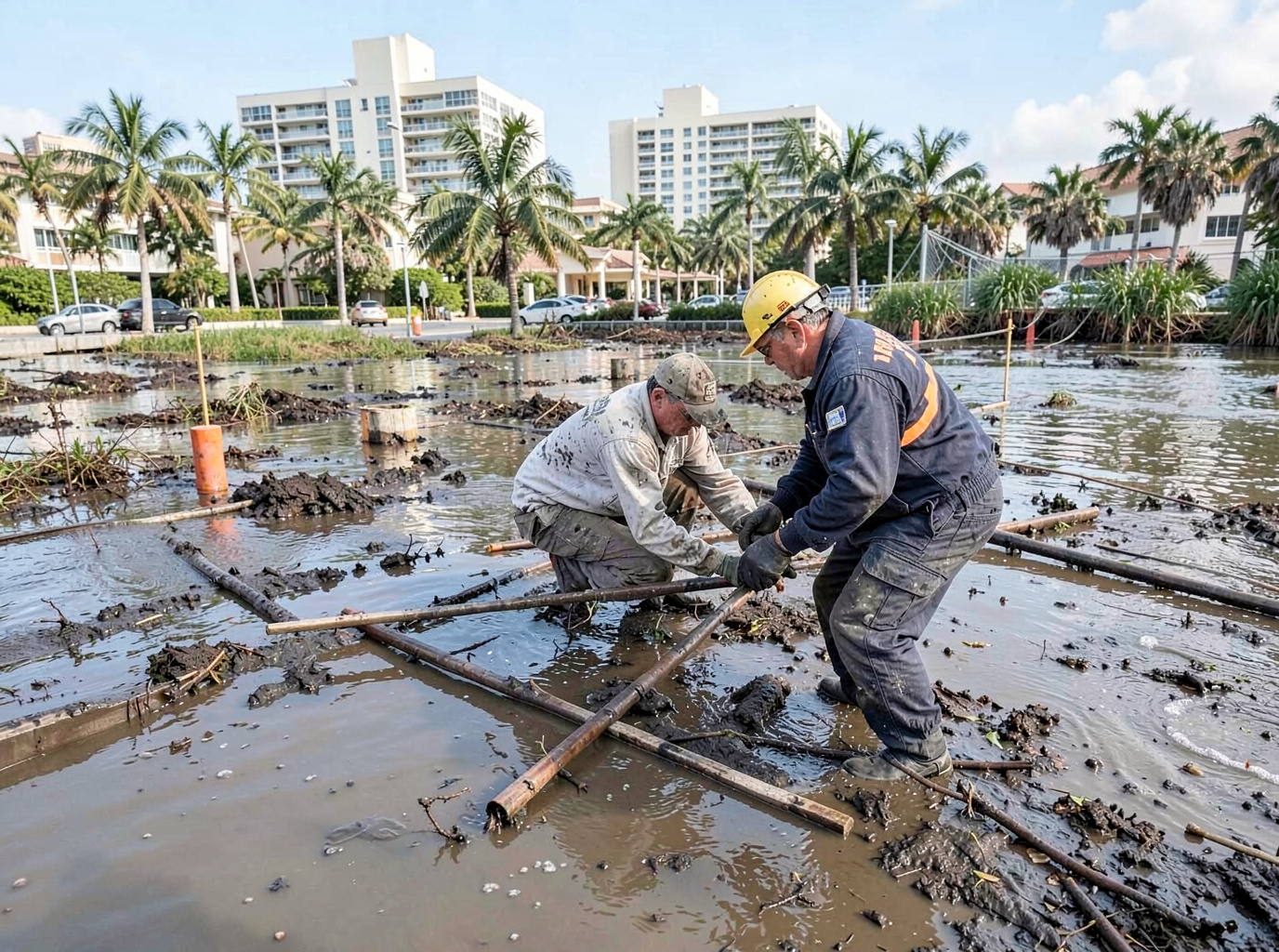
Flood damage restoration in Miami requires responding to both standing water and the slow, hidden migration of moisture into building cavities. In neighborhoods like Downtown Miami, Brickell and the Design District we commonly remove water from concrete slab homes, high-rise lobbies and low-lying storefronts near Bayside Marketplace and the Pérez Art Museum. In older neighborhoods such as Little Havana, Overtown and parts of Coconut Grove and Coral Gables, legacy construction details—pier-and-beam floors, clay block walls, and plaster ceilings—mean we check behind baseboards, under kitchen cabinets, and inside wall cavities for trapped water that can continue to wick even after surface drying.
Miami’s tropical monsoon climate with hot wet summers and frequent thunderstorms changes the job on the ground. Rapid drying in high heat can mask pockets of moisture; conversely, high humidity slows evaporation and increases the risk of mold growth in basements, crawlspaces and along slab edges. For properties near Marlins Park or Vizcaya Museum we take extra care with high groundwater and tidal influence when assessing perimeter grading and foundation weep paths. For commercial buildings in Brickell and Wynwood we coordinate with property managers to limit downstream damage to adjacent units and to document conditions for insurers.
Materials matter: gypsum board, engineered wood flooring and carpet-pad assemblies absorb water differently than concrete or porcelain tile. We remove and replace saturated drywall past the wet plane, lift edge-glued wood flooring to dry subfloors, and pull up tack strip and padding where contamination is present. In salt-air coastal locations like Coconut Grove and Miami Beach-adjacent properties, corrosive salts accelerate metal corrosion in HVAC and electrical components—so we check and flag mechanical equipment for an owner’s licensed contractor to evaluate electrical safety before power is restored.
Code and safety notes: when standing floodwater reached outlets or electrical panels we do not restore power ourselves but secure the scene and coordinate with the homeowner's electrician. We document conditions and drying readings; local building departments in Coral Gables or Miami-Dade may require permits for full rebuilds after extensive demolition. Business hours for scheduling are Mon–Fri 8am–6pm and Sat 9am–2pm. Where mold remediation is required, we contain work areas and use negative pressure to prevent spore migration into occupied spaces.
Technician insight
In Miami the biggest oversight I see is assuming heat alone will dry everything. High humidity after a thunderstorm can keep wood and drywall damp for weeks—especially in older Little Havana and Overtown homes with plaster cavities—so relying on fans without dehumidification usually leads to mold and repeat calls.
First-floor apartment flooded after a summer thunderstorm in Wynwood
Problem → A first-floor Wynwood apartment filled with several inches of dirty stormwater after a severe summer thunderstorm. What we found → Contaminated carpet, saturated baseboards, and moisture migrating up drywall behind built-in shelving. What we did → Extracted standing water, removed non-salvageable drywall base sections, installed targeted dehumidification and negative air to contain spores, and dried structure until moisture readings stabilized. Outcome → Unit cleared for reassembly and odor-free when tenant returned, with documented moisture readings for the property manager.
Flood Damage Restoration Services We Offer
✓Emergency Water Extraction
Rapid removal of standing water from homes and commercial spaces in Downtown Miami, Brickell and surrounding neighborhoods using truck-mounted pumps and portable extractors to reduce immediate structural damage.
✓Flood-Damaged Drying and Dehumidification
Strategic placement of air movers and low-grain refrigerant dehumidifiers to dry slabs, crawlspaces and wall cavities while monitoring moisture with meters until safe occupancy levels are reached.
✓Mold Remediation After Flooding
Containment, HEPA air filtration, and selective removal of mold-impacted materials with protocols suited to high-humidity Miami conditions—particularly for older homes in Little Havana and Overtown.
✓Structural Drying and Reconstruction Coordination
Controlled demolition of non-salvageable materials, framing repairs, and coordination with contractors for rebuilds in Coral Gables, Coconut Grove and other Miami-Dade neighborhoods.
✓Contents Recovery and Drying
Pack-out, on-site or off-site drying for furniture, documents and textiles with the goal of salvaging belongings whenever possible for residents near Vizcaya Museum, Marlins Park and other affected landmarks.
✓Crawlspace and Foundation Moisture Control
Inspection and drying of crawlspaces and perimeter slabs to prevent long-term moisture wicking in older homes around Coral Gables and Hialeah-influenced neighborhoods.
✓Sanitization and Odor Control
Antimicrobial treatments and odor control tailored for the hot, humid Miami climate to reduce bacterial growth and persistent musty odors after flood events.
How it works
- 1
1. Emergency assessment and containment
We arrive, evaluate hazards (electrical, sewage, structural), stop ongoing water sources where possible, and set up containment to protect unaffected areas.
- 2
2. Water extraction and removal
Standing water is removed using pumps and extractors; we focus first on high-risk zones like electrical rooms, HVAC closets and finished living spaces.
- 3
3. Drying plan and monitoring
We design a drying plan with airflow and dehumidification placements, take baseline moisture readings, and monitor until materials reach acceptable moisture levels.
- 4
4. Restoration and coordination
Selective demolition of unsalvageable materials, remediation (including mold if present), and coordination with contractors or property managers for rebuild or repairs.
Pricing
Pricing for flood damage restoration varies widely in Miami-Dade based on water category, square footage affected, and whether contents pack-out or reconstruction are needed; expect a wide range depending on contamination and demolition required.